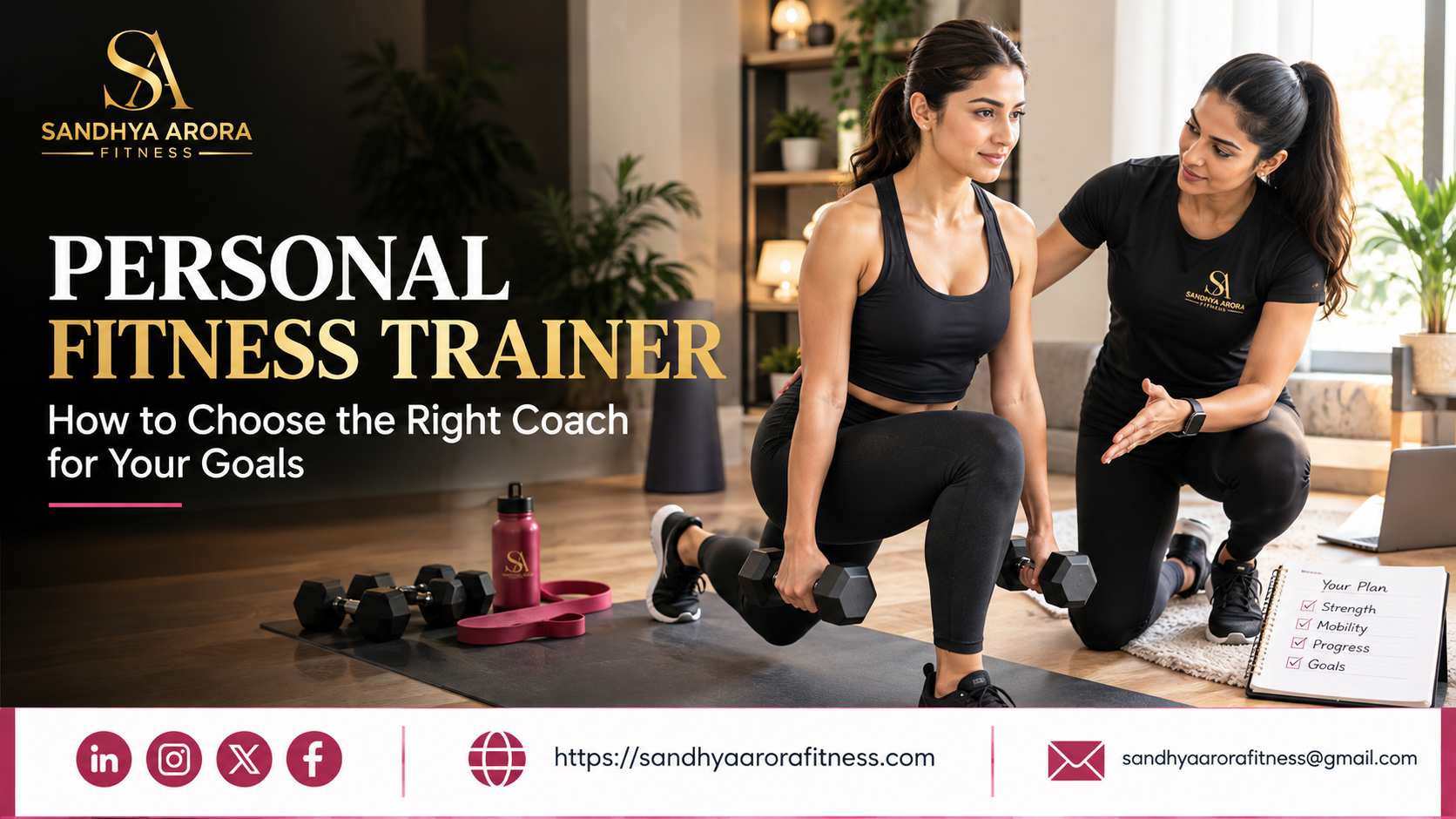
Choosing a personal fitness trainer is about more than finding someone who can demonstrate exercises. The right coach assesses where you are now, clarifies what you want to achieve, and gives you a realistic system for progressing week after week.
Personal fitness training can be delivered in a gym, at home, or online. In every format, the value comes from individual programming, coaching feedback, accountability, and adjustments that reflect your changing body and schedule.
This guide explains what a personal fitness trainer does, how to compare online and in-person options, what qualifications to look for, how apps support coaching, and how to find a trainer in Delhi or anywhere online.
If you're comparing formats, see our 1-on-1 personal training service, our online personal trainer guide, or our personal training cost guide.
How Personal Fitness Training Works
A home personal training relationship usually starts with the trainer understanding your space before building anything. This means seeing what room you have to move in, what equipment (if any) is already available, and any constraints like low ceilings, hard flooring, or noise-sensitive neighbours.
What a Personal Fitness Trainer Provides
The core of personal fitness training is personalized coaching: a plan, feedback, accountability, and practical adjustments that help you keep moving forward.
Space-Adapted Programming
Workouts designed to work within your actual room size, ceiling height, and flooring, not a generic gym routine.
Real-Time Form Correction
Hands-on cues and immediate feedback on technique, the same as you'd get in a gym, without leaving home.
Flexible Scheduling
Sessions built around your day, including early mornings, lunch breaks, or evenings after work.
Progress Tracking
A record of weights, reps, and how each session felt, reviewed regularly to guide your next program update.
What Equipment You May Need
Most home training programs need far less equipment than people expect. A good trainer will only recommend what genuinely improves your program.
| Equipment | What It's Used For | Is It Necessary? |
|---|---|---|
| Yoga or exercise mat | Floor work, stretching, and joint comfort | Recommended for most sessions |
| Resistance bands | Adding load to bodyweight exercises in a compact, portable form | Useful, not essential |
| Adjustable dumbbells | Progressive strength training without a full rack of weights | Helpful for strength-focused goals |
| Kettlebell | Full-body strength and conditioning in one compact tool | Optional |
| Stability ball | Core work and balance training | Optional |
| Pull-up bar | Upper body pulling exercises where a door frame allows it | Optional |
| No equipment | A full bodyweight program using space, tempo, and exercise order | Always a valid starting point |
Adapting Workouts to Limited Space
A small apartment or a single free corner of a room is enough for an effective session when the program is built around it. Trainers typically adjust for space in a few consistent ways.
- Vertical movement patterns (squats, lunges, step-ups) instead of exercises that need long floor distance
- Time-based intervals rather than long-distance cardio, keeping the workout intense without needing room to run
- Low-impact modifications for apartments or shared walls, swapping jumps for controlled tempo work
- Circuit-style exercise order that keeps you working in one spot rather than moving station to station
- Furniture-aware programming, using a sturdy chair or wall for support where needed
Benefits of Training at Home
Beyond convenience, several practical advantages consistently come up with clients who train at home.
No Commute
Time saved travelling to and from a gym often makes the difference between a consistent routine and a skipped one.
Privacy & Comfort
A private setting can make it easier to focus and build confidence without feeling watched, especially for beginners.
Easier Consistency
Removing the friction of travel and gym crowds makes it simpler to stick to a regular schedule.
Family-Friendly Timing
Sessions can be scheduled around childcare, work-from-home hours, or other responsibilities more easily.
Who Home Personal Training Works Best For
Home training suits a wide range of people, but it tends to work especially well for a few common situations.
- Busy professionals who need sessions to fit around unpredictable work hours
- New parents who can't easily leave the house for a full gym session
- Beginners who feel self-conscious training in a public gym setting
- People returning from injury who benefit from a controlled, familiar environment
- Anyone who simply prefers training in their own space over a shared facility
How to Choose a Personal Fitness Trainer
Whether you search for a personal fitness trainer near me, a personal fitness trainer in Delhi, or an online coach, compare the quality of the coaching rather than choosing on location alone.
- Ask about their personal fitness trainer certificate, continuing education, and experience with clients like you.
- Look for a coach who can explain the reasoning behind a plan, not just prescribe a list of exercises.
- Confirm that they conduct a proper health and injury screening before your first session.
- Check whether coaching includes progress tracking, nutrition guidance, and useful app-based communication.
- Read reviews, ask about results, and book a consultation to see whether their coaching style fits you.
Home vs Gym vs Online Coaching
Personal Training at Home
No commute, full privacy, and sessions built around whatever space and equipment you actually have.
Usually priced a little higher to account for the trainer's travel time.
In-Gym Training
Access to a full range of equipment and machines, useful for advanced strength or specialized programming.
Requires travel time and a membership or facility access.
Online Coaching
The most flexible and typically most affordable option, guided through video calls and app-based check-ins.
Relies more on your own self-direction between check-ins.
What Affects the Cost of a Home Personal Trainer
Home personal training is often priced a little higher than in-gym sessions, mainly because of the trainer's travel time and, in some cases, equipment they bring with them.
| Factor | How It Affects Cost |
|---|---|
| Trainer experience | More experienced or specialized trainers typically charge higher rates |
| Travel distance | Sessions further from a trainer's base area may carry a travel charge |
| Session length | Longer sessions cost more per visit but may offer a better per-minute rate |
| Package size | Booking sessions in bulk packages usually lowers the per-session price |
| Equipment provided | Trainers who bring their own equipment may price this into the session rate |
For a fuller breakdown of pricing across formats, see our personal training cost guide.
What a Typical Home Session Looks Like
Red Flags to Watch For
- No certification or insurance shared when asked directly
- No health or injury screening before starting your first session
- Pushy supplement sales unrelated to your actual training program
- No clear cancellation policy, leading to confusion around missed sessions
- Unwillingness to adapt exercises to your specific space or equipment
Personal Fitness Training with Sandhya Arora Fitness
Our 1-on-1 personal training is built around your goals, current fitness level, schedule, and preferred format. You can train in person, at home, or through structured online personal fitness training with coaching that adapts as you progress.
Paired with our nutrition coaching, your at-home training and eating habits move in the same direction. If your schedule shifts and you need more flexibility, our online coaching programs offer a natural next step without losing the personalization.
Frequently Asked Questions
How does personal fitness training work?
A personal fitness trainer starts by assessing your goals, experience, health history, schedule, and available equipment. They then create a progressive plan, coach your technique, track your results, and adjust the program as your strength and needs change.
Can I work with a personal fitness trainer online?
Yes. Online personal fitness training can include live video sessions, structured workout plans, progress tracking, nutrition guidance, and regular check-ins. It is a practical option for clients who need flexible scheduling or live outside the trainer's local area.
What should I look for in a personal fitness trainer certificate?
Look for a recognized certification, current first-aid knowledge, continuing education, and practical experience with clients who have goals similar to yours. A certificate matters, but so do the trainer's assessment process, communication, and ability to adapt a program safely.
How much does a personal fitness trainer cost?
Home personal training is often priced somewhat higher than in-gym sessions because of the trainer's travel time and, in some cases, equipment they bring with them. Exact pricing depends on session length, package size, and your location, so it's worth asking for a clear rate breakdown before committing.
How do I find a personal fitness trainer near me?
Search for trainers in your area, review their qualifications and client results, confirm whether they offer in-person or online sessions, and book a consultation. Clients in Delhi can also ask about travel areas, home visits, session packages, and the trainer's screening process before starting.
Key Takeaways
- Personal training at home can deliver the same personalized coaching and form correction as a gym session, adapted to your space
- Most effective home programs need minimal equipment, and bodyweight-only training is a valid starting point
- Small spaces can support a full workout using vertical movement and time-based intervals
- Always confirm certification, screening process, and cancellation policy before hiring a trainer to come to your home
- Choose based on your own schedule, privacy preferences, and available space, not a belief that one format suits everyone
The best personal fitness trainer is the one who gives you a clear plan you can follow consistently. If you're ready for coaching that fits your life, reach out to Sandhya Arora Fitness for a free consultation.